Showing posts with label barter limitations. Show all posts

Monday, 27 July 2015

No Need Money Only Barter

Barter is a system of exchange by which goods or services are directly exchanged for other goods or services without using a medium of exchange, such as money. It is distinguishable from gift economies in many ways; one of them is that the reciprocal exchange is immediate and not delayed in time. It is usually bilateral, but may be multilateral (i.e., mediated through barter organizations) and, in most developed countries, usually only exists parallel to monetary systems to a very limited extent. Barter, as a replacement for money as the method of exchange, is used in times of monetary crisis, such as when the currency may be either unstable or simply unavailable for conducting commerce.

Economists since Adam Smith, looking at archaic societies, have used the inefficiency of barter to explain the emergence of money, the economy, and hence the discipline of economics itself. However, ethnographic studies have shown no present or past society has used barter without any other medium of exchange or measurement, nor have anthropologists found evidence that money emerged from barter, instead finding that gift-giving (credit extended on a personal basis with an inter-personal balance maintained over the long term) was the most usual means of exchange of gifts and services.

Barter Limitations:
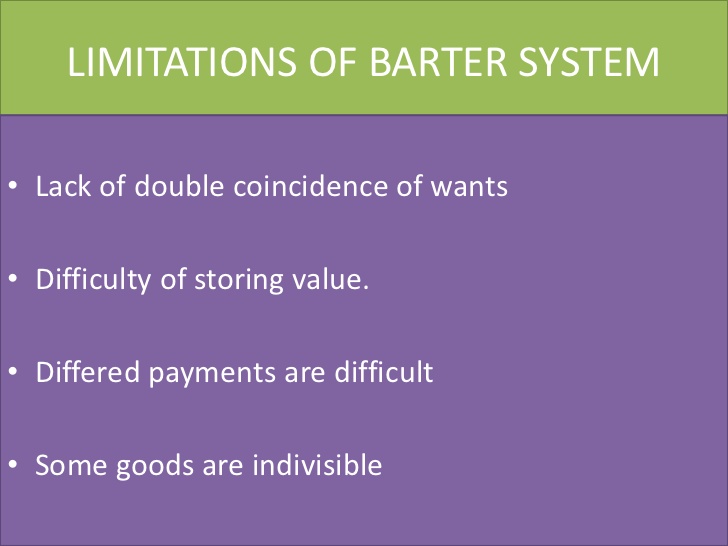
Barter's limits are usually explained in terms of its inefficiencies in easing exchange in comparison to the functions of money:
    Swap Products
  • Need Swap Products for presence of double coincidence of wants.
  • For barter to occur between two people, both would need to have what the other wants.     
  • Absence of common measure of value.
  • In a monetary economy, money plays the role of a measure of value of all goods, so their values can be measured against each other; this role may be absent in a barter economy.
  • Indivisibility of certain goods.
  • If a person wants to buy a certain amount of another's goods, but only has for payment one indivisible unit of another good which is worth more than what the person wants to obtain, a barter transaction cannot occur.
  • Lack of standards for deferred payments.
  • This is related to the absence of a common measure of value, although if the debt is denominated in units of the good that will eventually be used in payment, it is not a problem.
  • Difficulty in storing wealth.
  • If a society relies exclusively on perishable goods, storing wealth for the future may be impractical. However, some barter economies rely on durable goods like pigs or cattle for this purpose.
Barter Advantages:
  • Direct barter doesn't require payment in money (when money is in short supply) hence will be utilized when there is little information about the credit worthiness of trade partners or there is a lack of trust.
  • The poor cannot afford to store their small supply of wealth in money, especially in situations where money devalues quickly.

Barter Exchanges :
Swap Products Online
Modern barter and trade has evolved considerably to become an effective method of increasing sales, conserving cash, moving inventory, and making use of excess production capacity for businesses around the world. Businesses in a barter earn trade credits (instead of cash) that are deposited into their account. They then have the ability to purchase goods and services from other members utilizing their trade credits – they are not obligated to purchase from those whom they sold to, and vice versa. The exchange plays an important role because they provide the record-keeping, brokering expertise and monthly statements to each member. Commercial exchanges make money by charging a commission on each transaction either all on the buy side, all on the sell side, or a combination of both. Transaction fees typically run between 8 and 15%.

The Mool-mantra of this concept is No Need Money Only Barter to wipe-out the liquidity crisis that we currently face by helping you 'Trade, Swap, Replace ANYTHING". Your posts on this website would be absolutely free and even you strike a deal on your own. we don't want a penny out of it.

Barter window : Exchange : Trade : Swap: Replace Anything with Everything Else
Trade, Swap, Replace ANYTHING!  only at Barter window.
We don't charge you, we are here to help you.
Swap Products Online your product for the products published on the website.
Trade, Exchange, Swap and Barter....

"Paisa Mat Bol, Keemat se Tol"

Tuesday, 21 July 2015

Barter Terms Of Trade Limitations

Measuring the direction of movement of the gains from trade, this concept has important limitations.

1. Problems of Index Numbers: 
Usual problems associated with index number in terms of coverage, base year and method of calculation arise.

2. Change in Quality of Product:
Swap Products
Swap Products
The Swap Products terms of trade are based on the index numbers of export and import prices. But they do not take into account changes taking place in the quality and composition of goods entering into trade between two countries. At best, commodity terms of trade index shows changes in the relative prices of goods exported and imported in the base year. Thus the net barter terms of trade fail to account for large change in the quality of goods that are taking place in the world, as also new goods that are constantly entering in international trade.

3. Problem of Selection of Period:
Problem arises in selecting the period over which the terms of trade are studied and compared. If the period is too short, no meaningful change may be found between the base date and the present. On the other hand, if the period is too long, the structure of the country’s trade might have changed and the export and import commodity content may not be comparable between the two dates.

4. Causes of Changes in Prices:
Another serious difficulty in the commodity terms of trade is that it simply shows changes in export and import prices and not how such prices change. As a matter of fact, there is much qualitative difference when a change in the commodity terms of trade index is caused by a change in export prices relative to import prices as a result of changes in demand for exports abroad, and ways or productivity at home. For instance, the commodity terms of trade index may change by a rise in export prices relative to import prices due to strong demand for exports abroad and wage inflation at home. The commodity terms of trade index does not take into account the effects of such factors.

5. Neglect of Import Capacity:
The concept of the commodity terms of trade throws no light on the “capacity to import” of a country. Suppose there is a fall in the commodity terms of trade in India. It means that a given quantity of Indian exports will buy a smaller quantity of imports than before.

Along with this trend, the volume of Indian exports also rises, may be as a consequence of the fall in the prices of exports. Operating simultaneously, these two trends may keep India’s capacity to import unchanged or even improve it. Thus the commodity terms of trade fails to take into account a country’s capacity to import.

6. Ignores Productive Capacity:
The commodity terms of trade also ignores a change in the productive efficiency of a country. Suppose the productive efficiency of a country increases. It will lead to a fall in the cost of production and in the prices of its export goods.

The fall in the prices of export goods will be reflected in the worsening of its commodity terms of trade. But, in reality, the country will not be worse off than before. Even though a given value of exports will exchange for less imports, the country will be better off. This is because a given volume of exports can now be produced with lesser resources, and the real cost of imports, in terms of resources used in exports, remains unchanged.

7. Not Helpful in Balance of Payment Disequilibrium:
The concept of commodity terms of trade is valid if the balance of payments of a country includes only the export and imports of goods and services, and the balance of payments balances in the base and the given years. If the balance of payments also includes unilateral payments or unrequired exports and or/imports, such as gifts, remittances from and to the other country, etc., leading to disequilibrium in the balance of payments, the commodity terms of trade is not helpful in measuring the gains from trade.

8. Ignores Gains from Trade:
The concept of commodity terms of trade fails to explain the distribution of gains from trade between a developed and under-developed country. If the export price index of an underdeveloped country rises more than its import price index, it means an improvement in its terms of trade. But if there is an equivalent rise in profits of foreign investments, there may not be any gain from trade.

Swap Products Online
To overcome this last difficulty, Taussig introduced the concept of the gross barter terms of trade.

Barter window : Exchange : Trade : Swap: Replace Anything with Everything Else
Trade, Swap, Replace ANYTHING!  only at Barter window.
We don't charge you, we are here to help you.
Swap Products Online your product for the products published on the website.
Trade, Exchange, Swap and Barter....

"Paisa Mat Bol, Keemat se Tol"